
If you’ve ever felt like blogging “should be working” but isn’t… you’re not alone.
Most business owners are either:
- Not blogging at all
- Blogging inconsistently
- Or following outdated SEO advice that doesn’t actually move rankings
After working with hundreds of service-based businesses at Effective Web Solutions, I can tell you this:
Blogging still works. But only if you do it strategically.
Let’s break down what actually works right now—and what doesn’t.
What Actually Moves the Needle (Real Example)
We worked with a wood floor refinishing company that was barely visible in search.
- Ranking for: ~35 keywords
- Strategy implemented:
- Targeted People Also Ask (PAA) questions
- Built internal links to hyper-local service pages
- Created consistent blog cadence
In just 4 months:
👉 They jumped to 194 ranking keywords
No tricks. No hacks. Just execution.
The Biggest Blog SEO Mistakes (That Are Killing Your Traffic)
Let me be blunt—this is where most businesses go wrong:
1. They Don’t Do It At All
This is the most common issue.
No content = no authority = no rankings.
2. Terrible Internal Linking
Most blogs either:
- Don’t link at all
- Or link randomly with no strategy
Internal linking is one of the fastest ways to:
- Pass authority
- Help Google understand your site
- Rank your money pages faster
3. No Content Repurposing
You wrote the blog… and then what?
Most people stop there.
Meanwhile, that same blog could become:
- Google Business Profile posts
- Social media content
- Short-form videos
- Podcasts
If you’re not repurposing, you’re leaving traffic on the table.
My Non-Negotiables for Blog SEO
These are things we never compromise on:
- No keyword stuffing (Google is smarter than that)
- No repetitive anchor text (this can actually hurt you)
- Every blog links to:
- At least 3 other blogs
- At least 1 “money page” (service page)
- Old blogs get updated with links to new ones (this accelerates traction)
And one most people ignore:
👉 Consistency beats perfection every time
My Exact Blog Optimization Process (Step-by-Step)
Here’s how we actually do this in the real world:
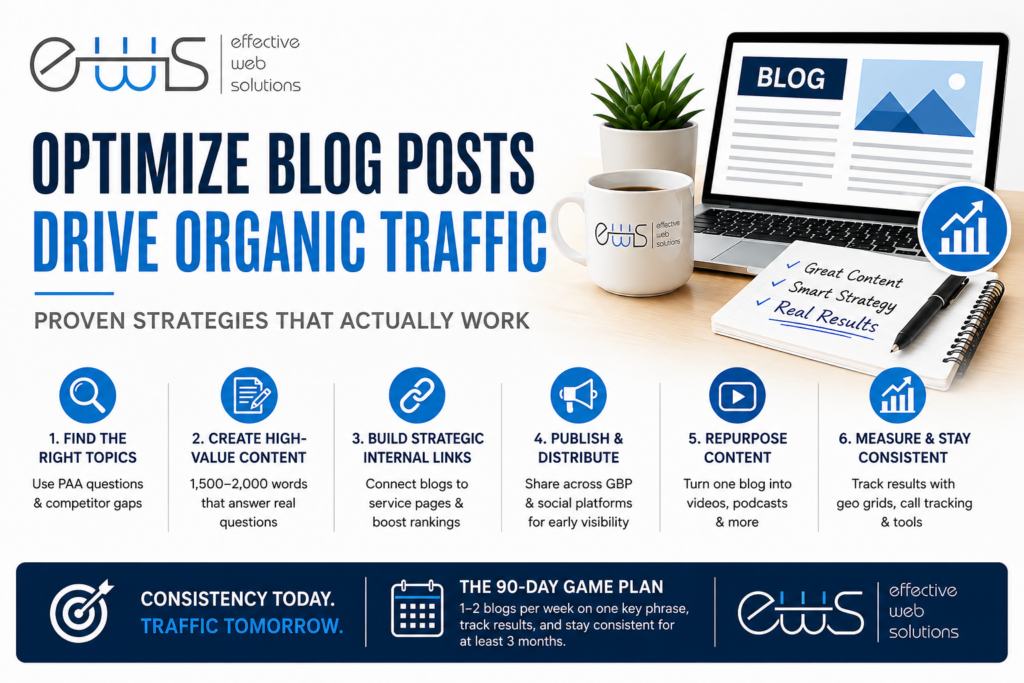
Step 1: Find the Right Topics
- Analyze competitor gaps
- Pull People Also Ask (PAA) questions
- Focus on what your customers are already searching
Step 2: Create High-Value Content
- 1,500–2,000 words per blog
- Structured with clear headings
- Written to answer real questions (not just rank)
Step 3: Internal Linking Strategy
- Use natural anchor text
- Link to:
- Related blogs
- Core service pages
- Continuously connect old and new content
Step 4: Publish + Distribute Immediately
Once the blog is live:
- Post it on your Google Business Profile
- Share it across all social platforms
- Link directly back to the blog
This helps:
- Faster indexing
- Early engagement signals
- Increased visibility
Step 5: Repurpose Into Multi-Channel Content
This is where most people fall short.
We take one blog and turn it into:
- Short-form videos
- Podcasts
- Social snippets
👉 One piece of content becomes 10+ assets
What You Should Do (If You Want Results Fast)
If you only take one thing from this article, make it this:
Your 90-Day Game Plan
- Write 1–2 blogs per week
- Focus on one key phrase per blog
- Do this consistently for at least 3 months
Track the Right Metrics
You won’t know if it’s working unless you measure it.
Use:
- Geo grids
- Call tracking numbers
- Ranking tools
Guessing = wasted time.
And Here’s the Truth Most Agencies Won’t Tell You
Google is not in a rush to reward you.
In fact…
👉 Google wants you to give up and just pay for ads
Most businesses quit right before it starts working.
The ones who win?
They stay consistent long enough to break through.
Final Thoughts
Blogging for SEO is not about writing more.
It’s about writing smarter, more connected, and more consistently than your competitors.
If you:
- Target real search intent
- Build internal authority
- Stay consistent
- And actually distribute your content
You will win organic traffic.
It’s just a matter of time.